Scientists looking at life in one of Earth’s hottest environments have found something remarkably tough.
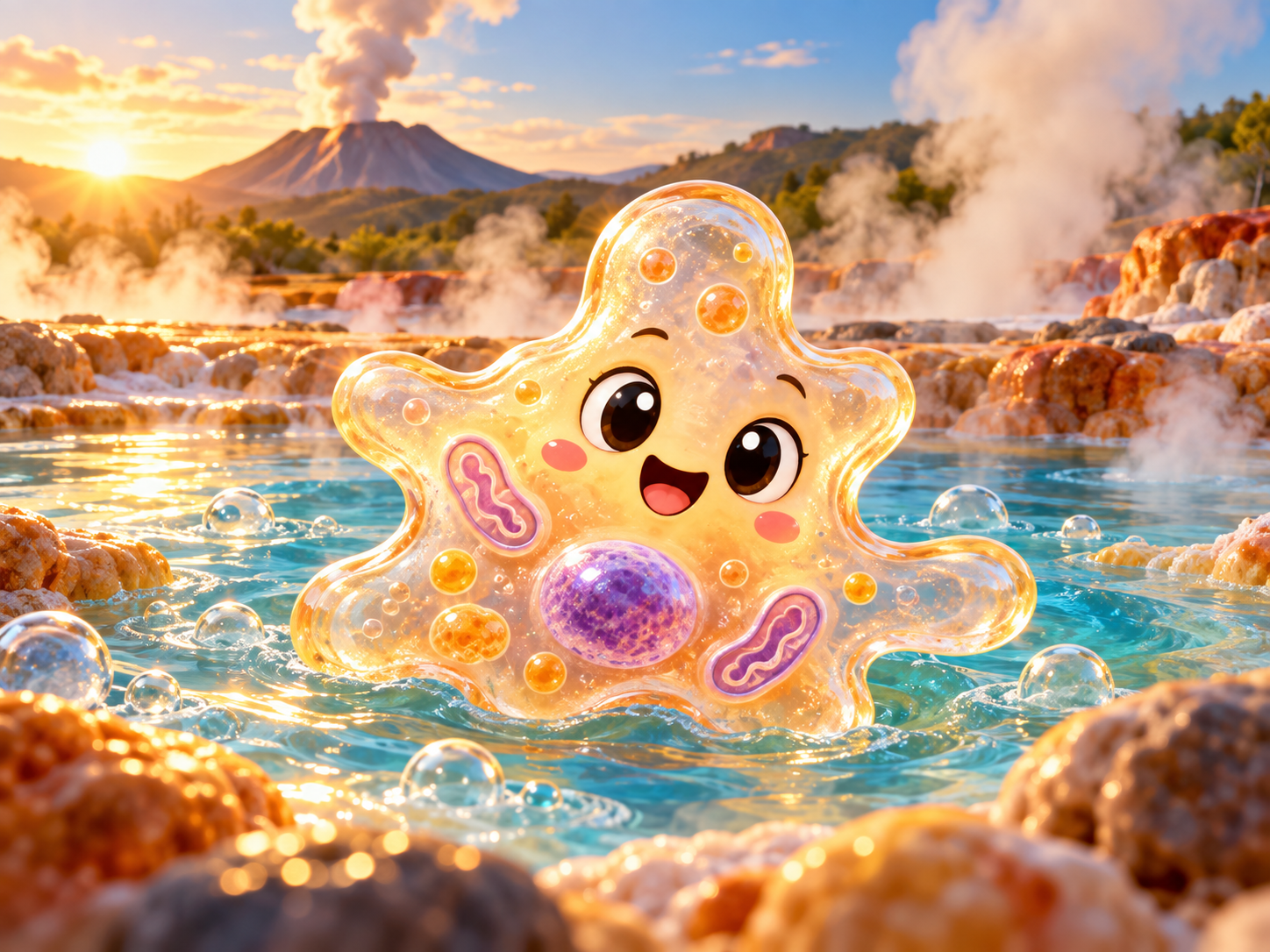
In the heated waters of California’s Lassen Volcanic National Park lives a newly described single-celled organism called Incendiamoeba cascadensis — a name that roughly evokes a “fire amoeba from the Cascades.”
And it likes things hot.
Researchers found that the amoeba can reproduce at about 145 degrees Fahrenheit, or 63 degrees Celsius. That sets a new known upper-temperature record for eukaryotic life — the broad group of organisms whose cells contain a nucleus, including animals, plants, fungi, and many single-celled organisms.
The amoeba stops reproducing above that point, but it does not immediately give up. Scientists observed it still moving at around 147 degrees Fahrenheit, and it was able to recover after being exposed to 158 degrees Fahrenheit for five minutes. At 176 degrees, however, it could no longer recover.
That matters because complex cells contain delicate structures that heat can damage. Scientists had previously suspected that some of those cellular membranes could not remain stable above roughly 144 degrees Fahrenheit. The fire amoeba has now demonstrated otherwise.
Researchers also examined the organism’s genome and found genes connected to protecting DNA, maintaining proteins, and sensing its surroundings — possible clues to how it manages life under such extreme conditions. Similar genetic signatures have also appeared in geothermal samples from places including Yellowstone and New Zealand, suggesting related heat-loving amoebas may still be waiting to be discovered.
The discovery is interesting for more than just record-setting.
Scientists who study astrobiology — the search for life beyond Earth — use extreme environments on our own planet to better understand where life might be able to survive elsewhere. If complex cells can tolerate conditions once thought impossible, the boundaries scientists use when imagining habitable environments may need to expand too.
For now, though, the fire amoeba belongs to Earth.
And in a steaming California hot spring, something microscopic has reminded scientists that life still has plenty of surprises left.